
For my money, a terrific day trip is a visit to Oberlin and its wonderful Allen Memorial Art Museum.
Oberlin College’s museum opens its fall 2026 season with a dynamic slate of exhibitions and installations. From a major exhibition exploring how the histories of the lands on which we live are intertwined with Indigenous sovereignty and Black emancipation to student-led research on ancient Korean tomb ceramics and 19th-century Mexican embroidery samplers rescued from the imperial palace of Chapultepec, the season demonstrates the ways artists and objects illuminate histories of place, identity and belonging.
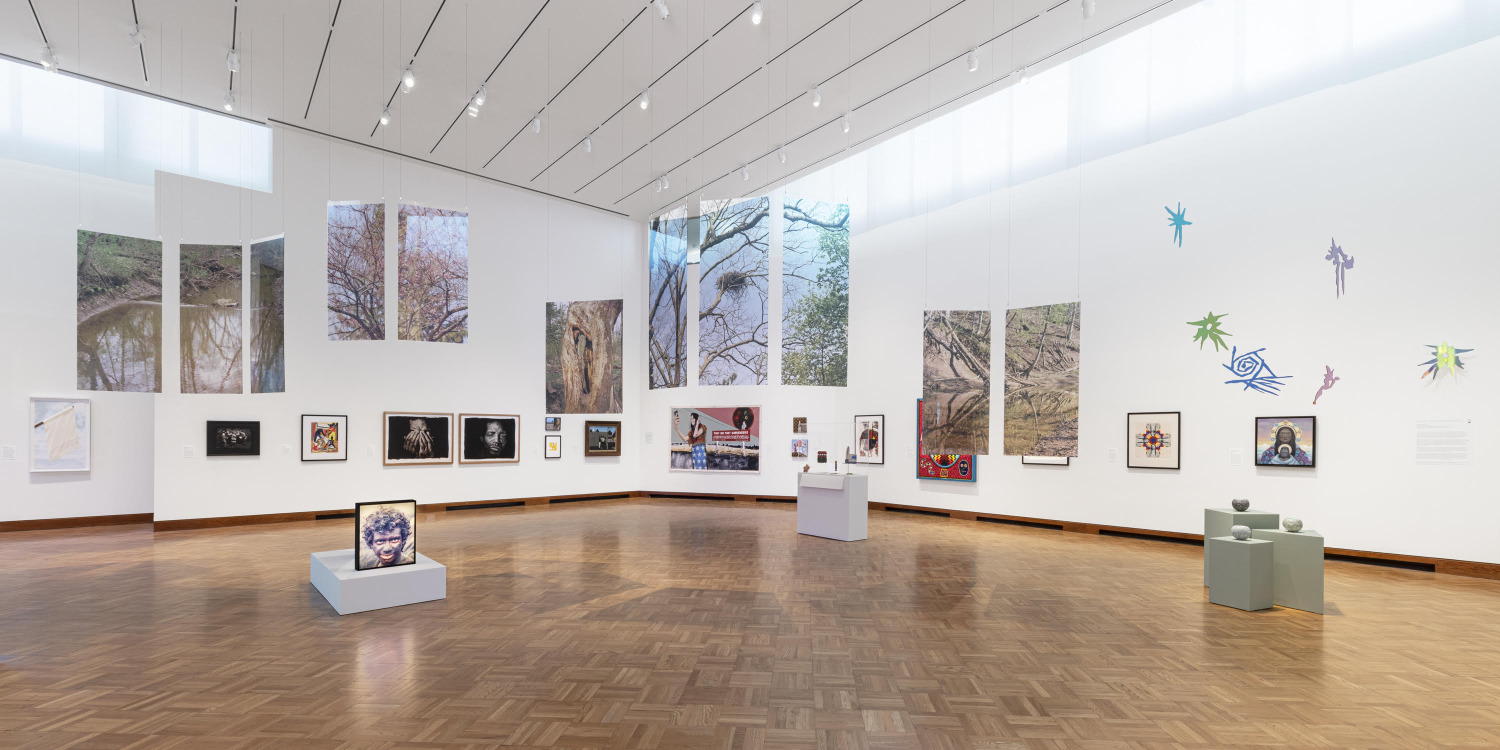
At the center of the season is The Land is a Being Who Remembers Everything, an exhibition organized by Sam Adams, Ellen Johnson ’33 Curator of Modern and Contemporary Art, and Marlise Brown, Associate Curator of European and American Art. Bringing together 300 years of art, the exhibition considers the histories embedded in the lands on which we live. Its title comes from “Conflict Resolution for Holy Beings,” a poem by internationally acclaimed Muscogee (Creek) poet and former U.S. Poet Laureate Joy Harjo.
On the Life, Breath, and Death of Trees, organized by Kevin R. E. Greenwood, Joan L. Danforth Curator of Asian Art, explores the resonance of trees at the intersection of East Asian art, human culture and global ecology. Historical paintings and prints appear alongside contemporary photography and video, inviting visitors to consider trees as artistic subjects, cultural symbols and living organisms essential to Earth’s fragile ecosystems. The interpretation explores twin paths of art history and ideas stemming from science and horticulture, presented by Oberlin staff and alumni.
Tomb Ceramics from Korea’s Three Kingdoms Period grew from original research by Student Curatorial Assistant Joanne Kim (OC 2026) in collaboration with Kevin R. E. Greenwood, Joan L. Danforth Curator of Asian Art. Featuring ancient Korean funerary ceramics from the Allen’s collection, the exhibition examines their artistic and technological significance while confronting complex histories of excavation, colonialism, collecting and the stewardship of cultural property.
Resilient Threads: Embroidery Samplers from 19th-Century Mexico grew from research by Student Curatorial Assistant Natalia Inéz Alvarado (OC 2025) in collaboration with Marlise Brown, Associate Curator of European and American Art. Featuring intricate samplers from the Allen’s collection presented for the first time, the exhibition explores the convergence of Indigenous Mexican and European artistic traditions through complex forms of needlework. Alvarado’s research considers cultural exchange, global trade and national identity while bringing greater attention to forms of artistic production — and the identities of makers — that have historically been marginalized within the traditional fine arts canon.
Beyond Woodblocks: Japanese Contemporary Prints explores the remarkable range of printmaking techniques embraced by artists in Japan from the 1960s through today. Moving beyond the country’s celebrated woodblock tradition, the exhibition features screenprints, lithographs, mezzotints and etchings that encompass subjects ranging from energetic abstractions and traditional architecture to cosmic imagery and luminous still lifes.
Vsitors will also encounter a newly reinstalled King Sculpture Court, where some of the Allen’s most extraordinary examples of global modern art return to view. Paintings by Monet, Picasso, Matisse and Modigliani appear alongside important works by Joan Mitchell, Howardena Pindell, Bob Thompson, Zao Wou-Ki and others, offering an expanded view of modern art upon entering the museum.
Photo courtesy Oberlin College