


Gardening Sweet Spots
By Donna Hessel
Color Comes First
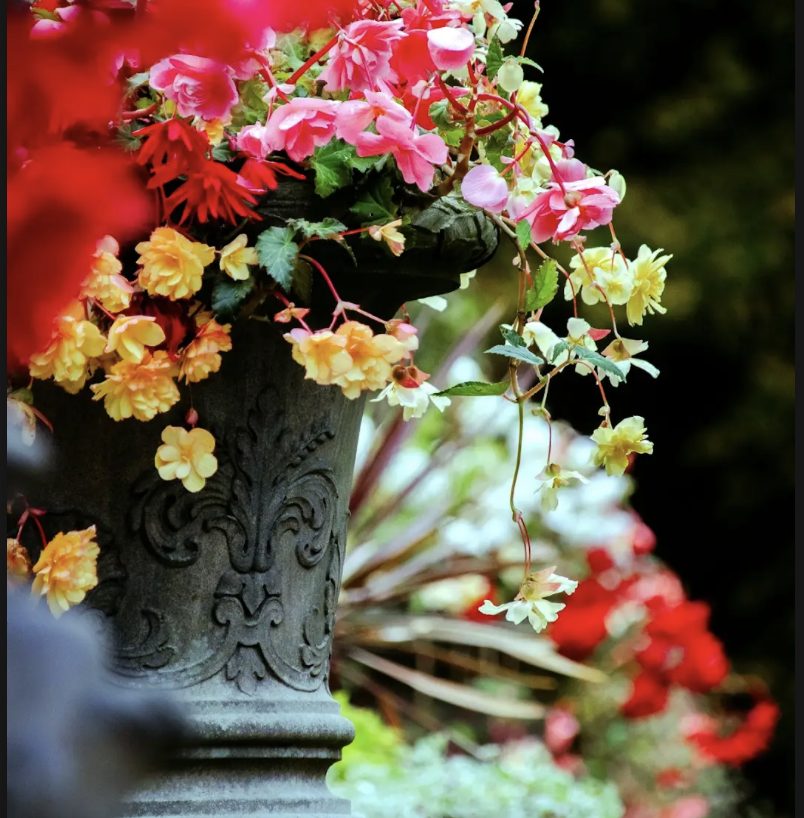
It’s always good to have a plan when shopping for container plants and “color” is a good starting point. Maybe you have individual pots in various places in your landscape. Or, maybe your whole garden, like mine, is all containers. Let’s consider various ways to plan colors for one or more containers.
The easiest container to create is a mono-culture one. That means one kind of plant per pot. Depending on the size of the pot, multiple plants of the same variety might be needed to fill the pot. This type of container planting is ideal for highlighting the container itself as a focal point in your garden or creating a single pop of color among foliage plants.
 A single plant variety in a range of color shades makes a statement.
Mono-color, or monochromatic designs include a range of shades of a single color. Different plant varieties, but at least two different shades of a color are ideal. Your choices mean colors will never clash and there is color variation. Mono-color designs are best viewed in a neutral color container.
If you like to see a variety of colors in a container, an analogous color scheme is your go-to container choice. Analogous colors are next to each other on the color wheel and mix together easily. Blooms that are yellow-orange or orange-red or yellow-orange-red or violet-red or blue-green or blue-violet and sample combinations. Colors can be bright or muted for variety.
A complimentary color scheme of reds and greens creates a welcoming entrance.
A complimentary color scheme always attracts attention. Complimentary colors are opposites on the color wheel: red-green; orange-blue; yellow-violet. In bright shades the contrast means both colors will stand out. Consider the intensity of the flower color when choosing plants. Remember that the container color can be a part of the color scheme. Picture a cobalt blue container with orange or blue flower varieties for immediate drama in the garden! A triad scheme is more difficult to achieve but equally dramatic. Two basic triad schemes are red-yellow-blue and violet-orange-green. Give some thought to including neutral colors. They can be used with any color scheme to add dimension.
Colors can be categorized as “hot” or “cool.” Cool colors are blue, pink and purple. Hot colors are red, orange and yellow. Hot colors will draw attention and work well by doors, paths or as focal spots in a landscape. Cool colors evoke calm and tranquility and work well in areas designed for relaxing.
Next Step: Design“Thriller, Filler, Spiller” always works well.
Most of us are familiar with the “thriller, filler, spiller” structure for containers. Thrillers are the vertical element in the container that adds height. It can be either flowering or just foliage. Some examples are spikes, tall grasses and angelonia. Thrillers can be placed in the center of a container if it is viewed from all sides, or at the back if the container is viewed from just one side.
Fillers are more rounded or mounding plants. They are placed in front of or around the thriller, midway between the edge of the pot and the thriller. Some fillers you might choose are euphorbia, lantana or nemesia. Fillers can be more than one variety of plant. Spillers are plants that will flow over the edge of the container. They can be planted at the front of the container if it is viewed only from one side; or on all sides. Spillers include sweet potato plants (many color varieties to choose from), licorice, creeping jenny, lobelia, verbena and calibrachoa petunias. Hanging baskets only need a mixture of spillers and fillers.
Add Foliage and Texture
Two good examples of effective foliage and texture mix.
Green foliage is a great way to add variety to a container. Green is considered a neutral plant color. Silver, black, chartreuse, bronze and variegated foliage complement flower colors. Dark leaves create drama and contrast. Silver foliage blends with soft colors and chartreuse will set off reds, oranges and yellows to create a tropical feel. Texture relates to the size, shape and arrangement of plant surfaces. Both foliage and blooming plants have texture; e.g., hairy, smooth, crinkled, etc. Containers of plants with similar textures are seen as a whole, while containers with a variety of textures will draw attention to specific plants as well as the whole arrangement.
Pastels create a relaxing venue and dark leaves heighten contrast.
Other Considerations
Choose plants that have similar growing conditions for each container. Will the planter be in sun or part sun, part shade? Full-sun plants need at least six hours of direct sun per day and generally prefer warm afternoon sun. Part-shade plants need 4-6 hours of sun, while full-shade plants will grow with less than four hours of sun per day. Check the plant label to see how much water each plant will need and group together those that need consistently moist soil vs. drought-tolerant plants. Try to group vigorously growing plants together so one plant doesn’t overtake another. And, best not to plant something described as “petite” with a plant that has a sprawling habit.
Group plants with similar growing conditions together.
Planting: How Many Plants and How to Place Them
Most of us are planning “traditional” arrangements vs “living flower” arrangements that look fully grown and gorgeous immediately but will not look good for a whole season. For a traditional arrangement, the usual plan is to use three or four plants in 10- to 12-inch planters; four to six plants in 13- to 16-inch planters and six to eight plants in 16- to 18-inch containers. These quantities will allow room for growth and plants will be healthier; they will bloom and look good to the end of the season.
Also to consider are the final size of the plants and how vigorously each one grows, as well as the size of the plants you purchase. If you are buying 6-packs of plants, it will take more plants than if you are starting with 4-inch pots. Likewise, if you buy gallon-size plants, even fewer will be needed. The spacing recommendation on the tag is a good indicator of how many plants to buy. Smaller spacing between plants means plants will be smaller and less vigorous; a larger spacing recommendation equals larger and more vigorous plants.
A border of individual plants in containers accommodates a variety of plant growing preferences.
When filling containers with soil, leave a half inch of headspace between soil and the top of the planter edge. An inch or even two inches of headspace is good for larger containers. Headspace keeps the soil from washing out and channels water into the container. Leave some room to add a bit of mulch also. Leave an inch or two between the edge of the pot and the closest plants so plants have room to spread roots in all directions. After planning this spacing, place the plants somewhat evenly throughout the planting area, taking into consideration the direction from which the planter will be viewed and the angle from which the thrillers, fillers and spillers will look their best.
Make sure your containers have drainage holes! Purchased planter feet to raise the container above soil level will enhance drainage. Or, you can use three or four lids from peanut butter or mayonnaise jars to arrange under containers to raise them up.
You’ve aced the basics. Now get planting and create the best containers you’ve ever made!
Article Resources:
Proven Winners “Winners Circle” Online Newsletter – 3-4-22 – Container Planting
“Container Garden Design – Planting – Color – Structure – Foliage and Texture,” ContributorKerry Meyer
Proven Winners “Winners Circle” Online Newsletter – 3-4-22, “Five Tips for Choosing Container Companions,” Contributor Susan Martin
Yvette Gary
The deer have decimated flowers in my yard. What is the solution? Any advice?
Estelle R. Brown
Hi, Yvette. Unfortunately, many of us share your experience. Fortunately, Donna wrote a blog post on how to deter deer from your garden: https://www.northeastohiothrive.com/blogger/oh-deer-how-keep-deer-out-of-your-garden/